The Raunacht Collection a collection of 12 poems reflecting the in-between time, the 12 nights, the time of the wild hunt. Reminiscence and mystical themes
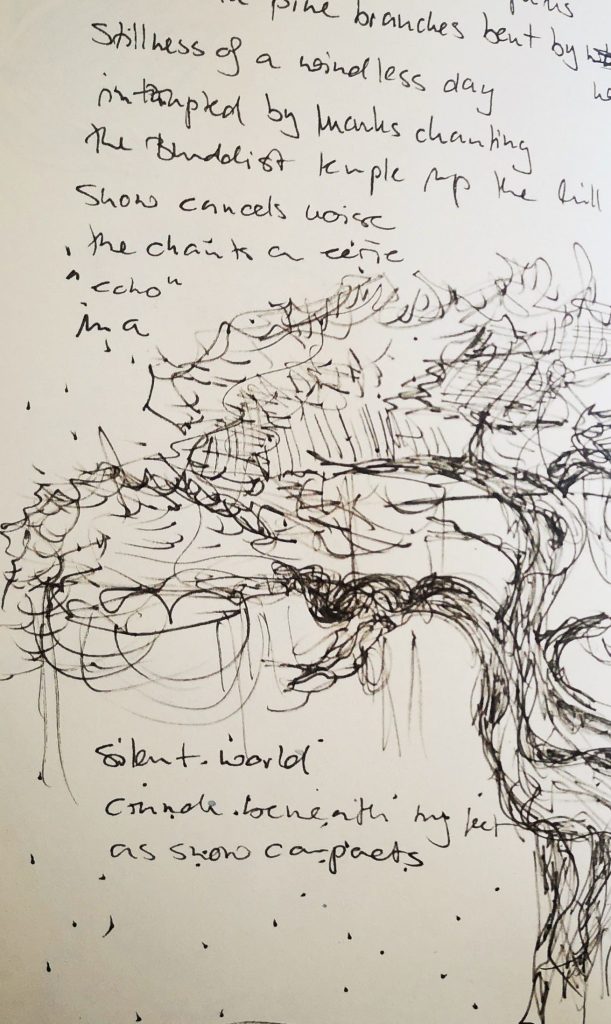
Knee deep snow beyond the paths Mountain pine branches bent by white weight Stillness of a windless day Monks’ chanting In the Buddhist temple at the apogee The only noise besides the crunch of snow underfoot
The chants an eerie iterance In a silent world Carrying us up the mountain Breath visible in frozen air I am in this world and other world Walking the liminal space Floating in a white suspense
Prayers as metronome On a snow-muted day I am here, and now And always and everywhere In this moment
Your rough-hewn hands Move over my anxious skin. Head, neck, shoulders, arms, hands. Head, neck, shoulders, arms, hands. Again. Again. Again. Again. A little twirl, more emphasise as you move over my hands, and out and away. I ought to sleep. Alas I can’t. My skin burns from carrying the day: smells, sounds, colours have seeped into my epidermis, setting the organ alight. My stomach churns with thoughts and questions. My brain spin tales and stories. It won’t stop. So you begin to sing. Let the sound carry all away. Let the sound quiet the stories soothe the stomach. All the while your hands move in their duty of gathering an anxious child back into her body.
Joyful chimes Dance through the winter’s eve. We are wrapped tightly, In thick scarves and coats like down blankets. Woolie socked feet, in big boots, Crunch their way along the dark road, Carefully determined, Towards the sound of the bells.
Waiting are candle light, warm hugs from friends, carols to be sung, and nativity play. Our noses numb with cold, Mother, sister, me.
Stars decorating the dome above Like the candles on our tree. Snow is sparkling tinsel along the wayside. We celebrate the light born. Sun rising again and the days growing. Stories blending into rituals, Ancient tales in new dress.
The path, a road now, Once carried mammoths, And neolithic tribes. And still we strive to the building on top of the highest elevation. Coaxed by the sound of the bells, To celebrate light reborn. As we have done and will continue to do, As long as the sun rises the next morning.
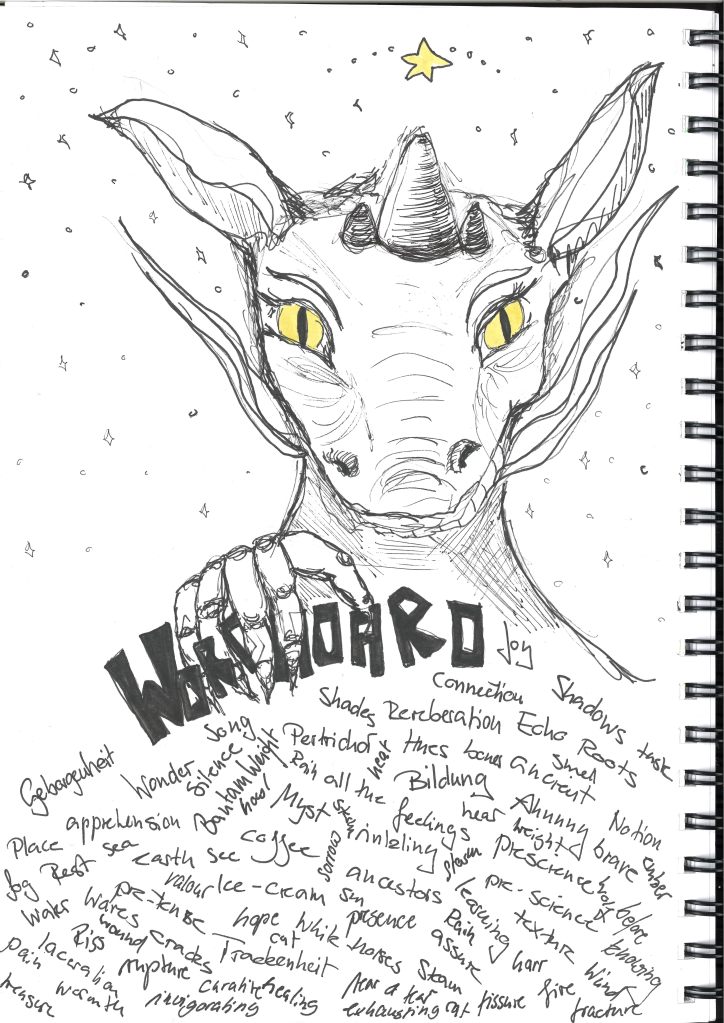
So I signed up for BBC Maestro–yay Black Friday Deals! And begun with the poetry class by Carol Ann Duffy. I had to share my homework for one of the metaphors she introduced: word hoard.
I so loved the idea of a word hoard and of course there must be dragons if there is a hoard!
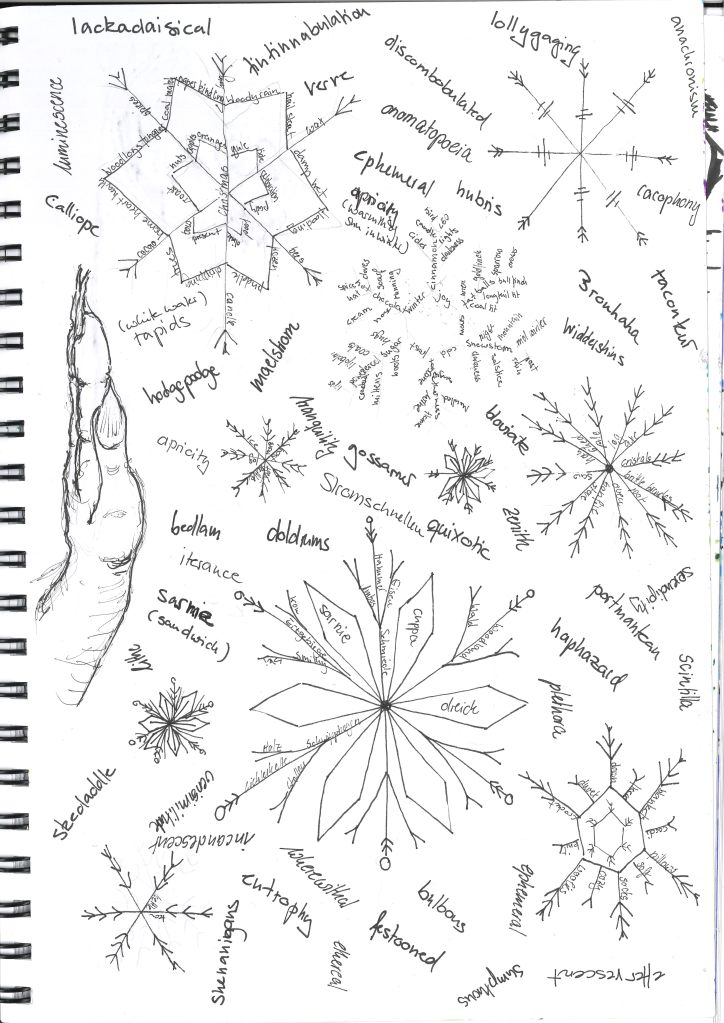
My first word hoard
Raunacht Collection
The course has inspired me to write a whole host of poems. And I picked twelve to put in a kaleidoscope of memories. They wanted to be called the Raunacht Collection. It is scheduled to go live on the 24th.
If you don’t know the term, Google Bard was much better explaining this than I:
Rauhnächte: Twelve Nights
This is the time when the wild hunt rides and the spirits run wild.
The Raunächte, also known as the Twelve Nights, Rauhnächte, or Holy Nights, are a period of twelve nights and days between Christmas and Epiphany (December 25th to January 6th). It’s a time steeped in folklore, tradition, and a touch of the mystical, observed primarily in Central and Eastern Europe, particularly in Germany, Austria, Switzerland, and parts of Scandinavia.
-Google Bard
Origins and Traditions:
The origins of the Raunächte can be traced back to pre-Christian times, possibly linked to pagan winter solstice celebrations and veneration of nature spirits. With the spread of Christianity, the period became interwoven with the Nativity story and themes of spiritual renewal.
Traditionally, the Raunächte were seen as a liminal space, a threshold between the old year and the new, when the veil between the worlds was thin. This belief led to various customs and rituals, often centered around warding off evil spirits, divining the future, and ensuring good fortune for the coming year.
The etymology of the word “Raunacht” is uncertain. There are two main interpretations:
The first interpretation is that the word comes from the Middle High German word “rûch” meaning “hairy”. This interpretation could refer to demons dressed in fur or to rituals involving livestock.
The second interpretation is that the word comes from the traditional practice of fumigating stables with incense. This interpretation is also supported by historical evidence.
 Poetry by Nathalie